Aasaan Checkout — the marketplace hub D2C merchants actually wanted.
Aasaan is a 1-click checkout for D2C brands. The PM brief: design a feature that helps merchants consolidate operations across multiple e-commerce platforms. The reality: every merchant I interviewed was already losing money to a problem nobody had named yet — cross-platform inventory drift.
The product, in one sentence.
Aasaan is a 1-click checkout product for D2C brands — built to lift conversions, simplify the shopper experience, and give merchants visibility into their funnel. The pitch: +30% conversions, consolidated marketing dashboards, no minimum order volume to onboard.
That's the existing product. The PM challenge I worked on was different — what's the next feature Aasaan should build that pulls more value out of its merchant relationships? I started where any honest PM starts: by calling merchants.
"Design a feature to help D2C merchants consolidate their operations."
Three key goals embedded in the brief:
- Increase operational efficiency for merchants.
- Provide consolidated data insights across their various e-commerce platforms.
- Reduce costs related to inventory management and logistics — and reduce card abandonment as a side effect.
The brief was deliberately open. The work was figuring out which specific operational pain — across order management, inventory, fulfilment, returns — was worth solving first.
The unnamed problem: cross-platform inventory drift.
I interviewed two merchants — an e-commerce store owner and an online boutique owner. Their stories were specific, but the underlying pain was identical.
"If a product has 10 units in stock, I can't list it as 10 on every e-commerce platform. If the total orders across all platforms spike, I have to cancel orders — and then I get penalised by Amazon and Flipkart. The customer thinks I'm unreliable. The platform fines me. The inventory software that fixes this charges a commission on every order." Merchant 1 · interview
The merchants didn't have a word for it — but the problem is cross-platform inventory drift. Their stock is finite. The platforms each show the full stock. When demand stacks across platforms, somebody gets cancelled, and the merchant pays the bill three different ways: the lost sale, the platform penalty, and the customer-trust hit.
Existing solutions, and why merchants disliked them
Third-party inventory management tools (Unicommerce was the example named) exist. Merchants weren't using them because they charge a commission on every order. For a merchant on thin margins, commission-based pricing on every single SKU sold across every platform is a non-starter.
How Aasaan stands out.
The landscape audit (Unicommerce, Browntape, Shopify multi-channel, etc.) made two things clear:
- Pricing model is the differentiator. Most competitors charge per-order commission. Aasaan's existing model (per-checkout, not per-order) is fundamentally more aligned with merchants on margin. The integration hub had to preserve that.
- India + Middle East focus is underweighted. Global tools don't customise for the Indian e-commerce reality (Flipkart and Amazon penalty structures, COD-heavy markets, regional payment quirks). Aasaan can.
What we could offer that they don't
- Universal convenience. One platform for inventory, listing, orders, analytics — across every marketplace.
- Customisation. The checkout already lets merchants customise the brand experience. The integration hub extends that to listing presentation and fulfilment flows.
- AI-driven insights. Pull data from every platform, surface decisions the merchant can actually act on. Not just dashboards — recommendations.
The personas, lifted from the interviews.
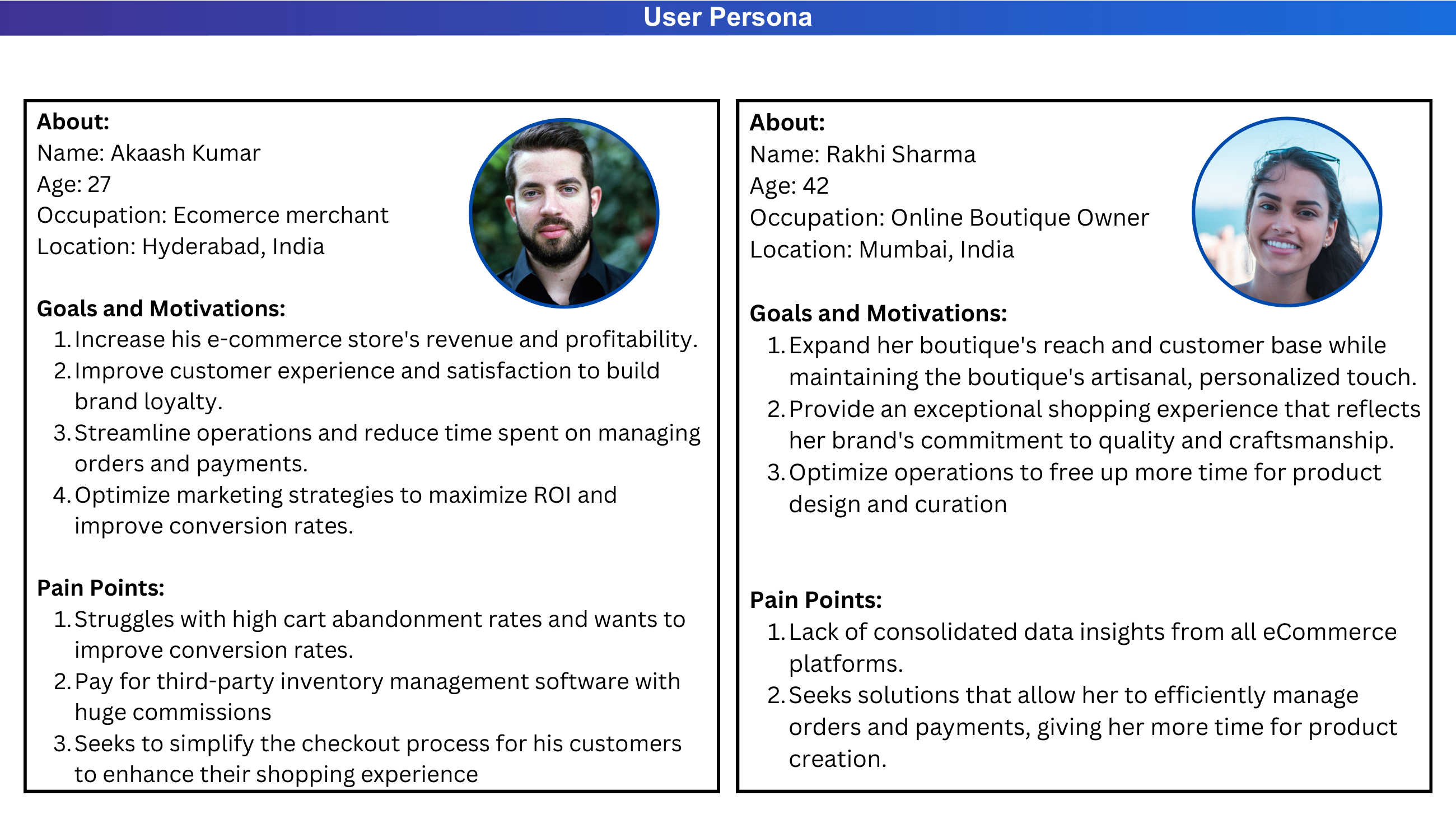
Akaash and Rakhi. Two different businesses, two different cities, one identical problem — inventory drift across platforms and no affordable way to fix it.
Akaash · 27 · E-commerce Merchant
Goals: grow revenue, lift conversion, reduce time spent on order management. Pain: high cart abandonment; paying third-party inventory tools that take commission per order; wants to simplify checkout for his customers.
Rakhi · 42 · Online Boutique Owner
Goals: expand her boutique's reach while keeping the artisanal touch. Pain: no consolidated view of data across e-commerce platforms; wants to spend her evenings designing, not managing orders.
What they share
Both are time-poor. Both are margin-sensitive. Both are losing some unmeasurable percentage of their revenue to inventory drift and platform-specific friction. Both will pay for a tool that doesn't take a cut.
One platform. Every marketplace. No commission per order.
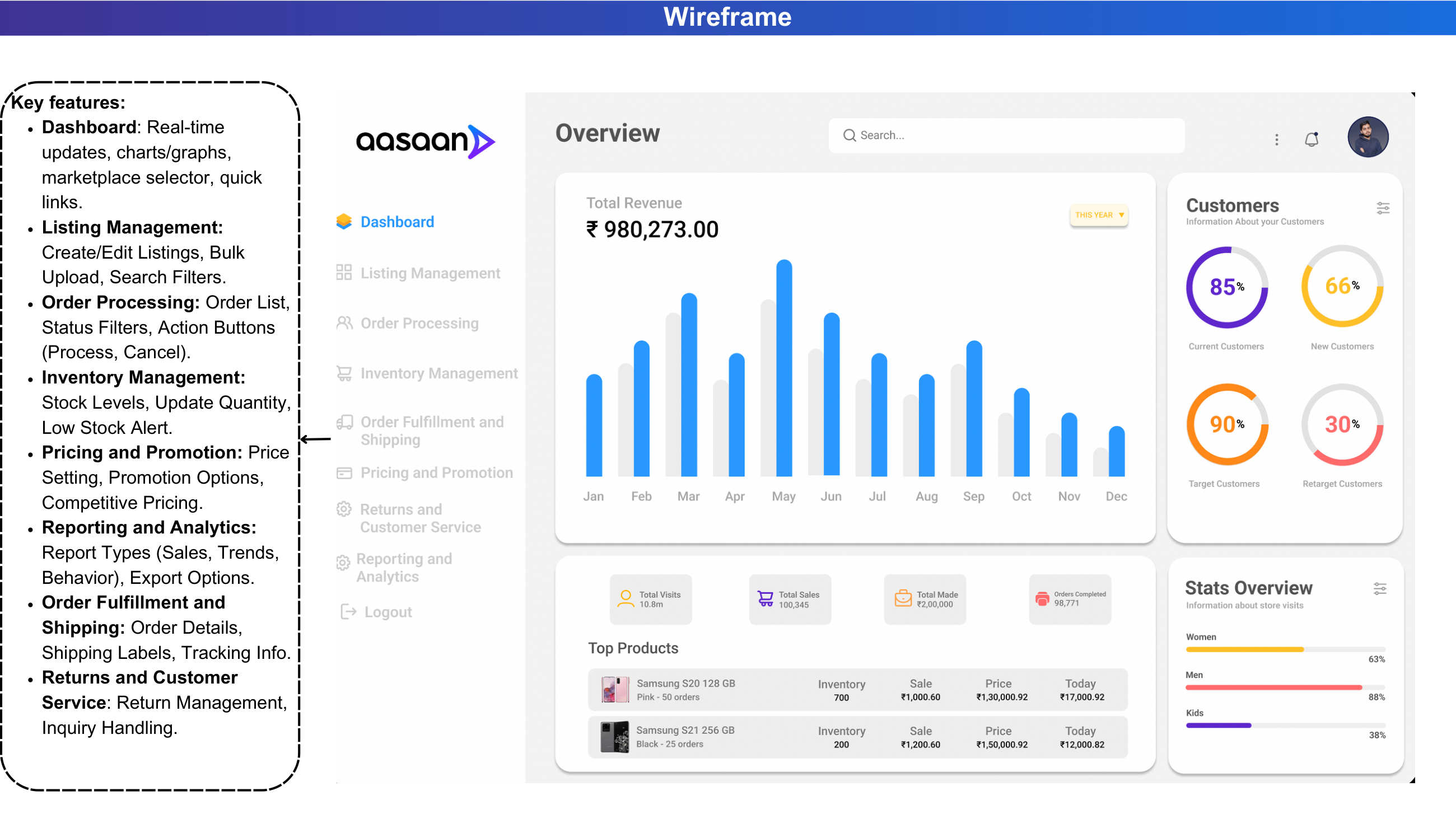
The wireframed integration hub dashboard: unified revenue chart, customer breakdown, top products with live inventory, and a left nav covering all eight functional pillars.
The proposed feature: the Aasaan Checkout Marketplace Integration Hub — a centralised dashboard that gives merchants real-time visibility and control across every platform they sell on. The pricing stays per-checkout, never per-order.
Eight functional pillars
- Unified Dashboard. Single pane for product listings, orders, inventory across all integrated marketplaces.
- Listing Management. Create, edit, and synchronise listings across platforms from one interface. Bulk upload for catalog refreshes.
- Order Processing. Receive and process orders from any marketplace within Aasaan. Auto-sync to prevent over-selling.
- Inventory Sync. Real-time stock-level updates across every connected platform. This is the headline fix to the drift problem.
- Price and Promotion Management. Set pricing uniformly or per-platform. Monitor competitive pricing in-app.
- Automated Reporting & Analytics. Cross-platform reports on sales, trends, customer behaviour.
- Fulfilment & Shipping. Integrated shipping labels, tracking, customer notifications.
- Returns & Customer Service. Manage returns and inquiries from every marketplace through one interface.
The 20% of features that solve 80% of the pain.
Eight pillars is a roadmap, not an MVP. To ship something merchants would adopt in 8 weeks, I'd cut to four:
- Unified Dashboard — non-negotiable. Without it, the hub doesn't exist.
- Inventory Sync — solves the named pain. This is why the merchants would switch.
- Order Processing — second priority. Required to stop merchants from logging into each platform separately.
- Listing Management — third. Bulk upload first, then sync.
Price management, analytics, shipping, returns — all v2. Critical to the long-term value but not what merchants are switching away from Unicommerce for.
The PRD
Full requirements live in the PRD: Notion ↗. Wireframes cover dashboard layout, order list views, inventory edit flow, and the bulk-upload pattern.
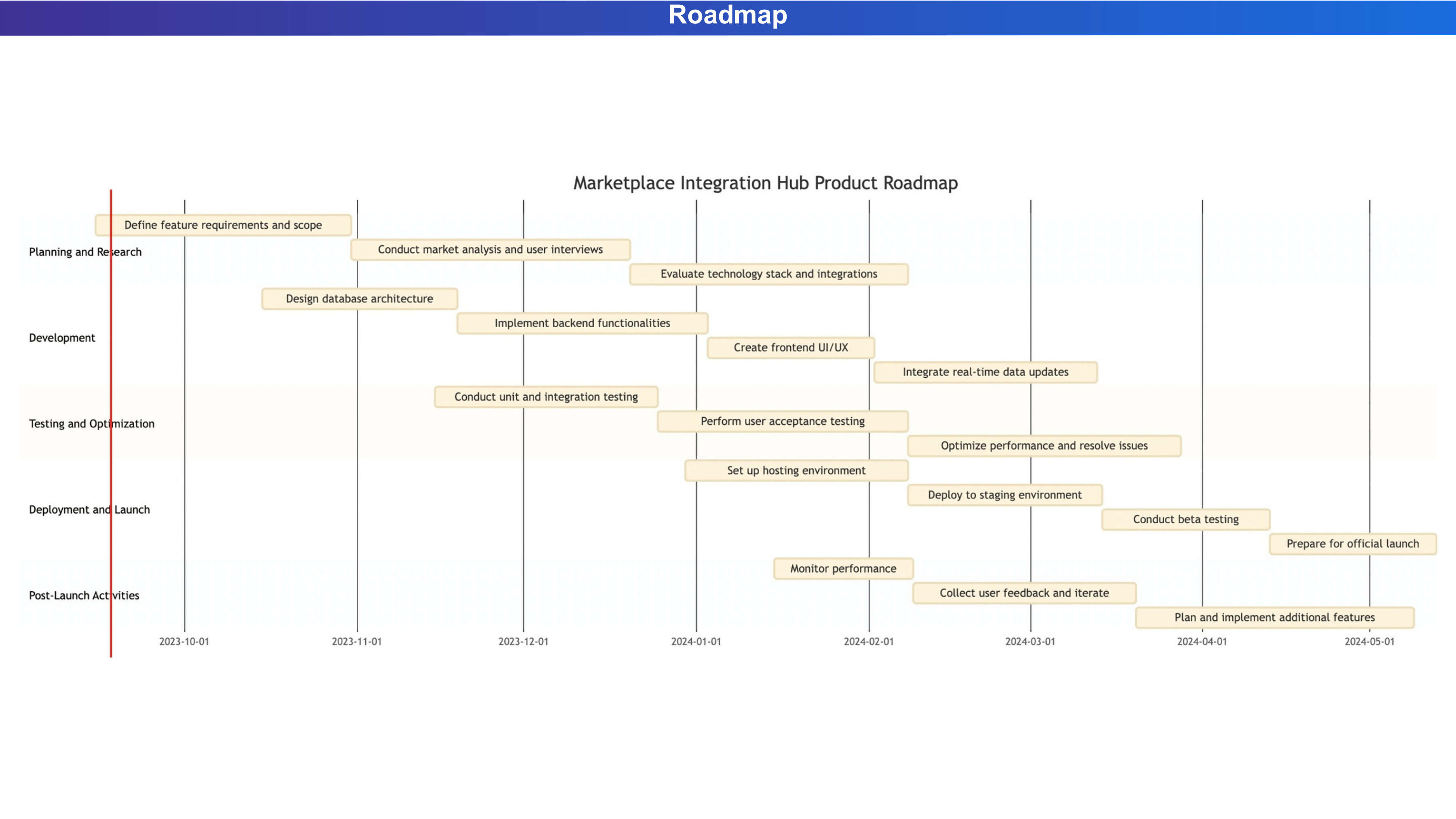
Product roadmap from planning through post-launch. Planning and Dev tracks run in parallel; Testing begins at week 6; Deployment targets Feb 2024 beta with official launch in April.
The numbers that say "merchants stayed."
Adoption metrics
- Number of users accessing the dashboard. The basic engagement signal.
- Listings created or edited. Are merchants moving their catalog ops into Aasaan?
- Bulk uploads completed. Power-user behaviour signal.
Operational metrics
- % of orders accurately synced and fulfilled on time. The fix for the inventory drift problem, measured.
- % of customers receiving low-stock notifications. Are we surfacing the right alerts at the right time?
- Frequency of competitive pricing monitoring. Engagement with the pricing layer.
Business metrics
- Number of shipping labels generated / shipments tracked. Fulfilment integration health.
- Returns and inquiries handled through the unified interface. Stickiness signal — merchants doing more of their support work inside Aasaan.
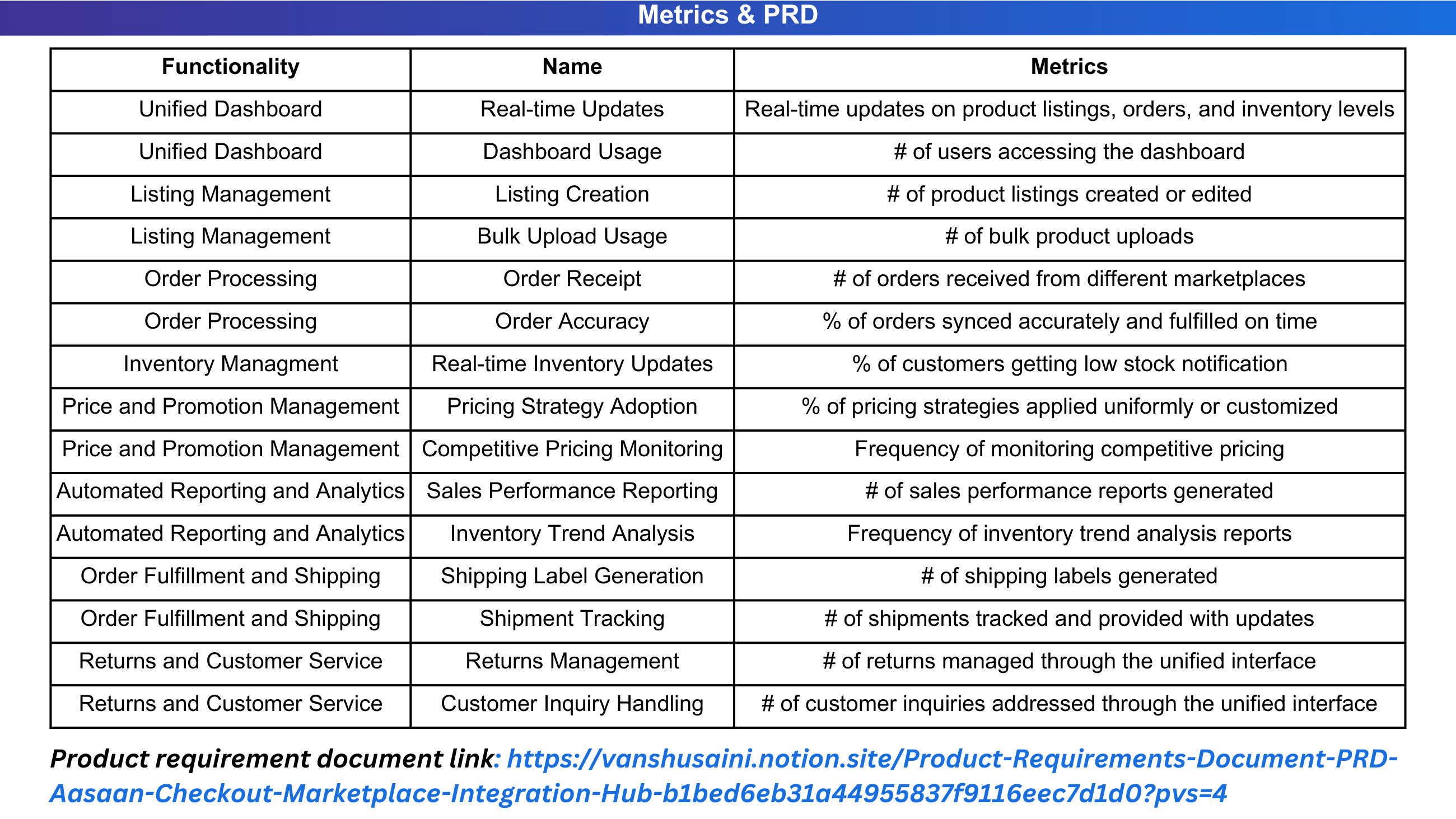
15 success metrics mapped to each functional pillar. Every feature ships with a named metric so there is no ambiguity about what "working" looks like post-launch.
The north star
Not any of the above directly. The north star I'd argue for: weekly active merchants performing at least one cross-platform action in Aasaan. If the hub is the place merchants check first when they sit down to manage their store, the product has won.