Freese — building a platform for a conversation India isn't having.
One weekend at Masters' Union. Four personas, six VC pitches, one no-code MVP, and ₹3,00,000 in grant funding. This is the story of a product built from a conversation nobody was supposed to overhear.
It started in a campus corridor.
I was at Plaksha when a friend brought up her PCOS diagnosis. Not as a one-off conversation — as a recurring weight she carried. What struck me wasn't the medical detail. It was that she had no idea where to go. Not a single platform pulled together verified clinics, financing, or even basic awareness content.
A week later, Masters' Union announced their Startup Weekend. The brief: take an idea from blank page to VC-pitchable MVP in 48 hours. I picked the topic nobody else would touch.
Three forces, one void.
Egg freezing — clinically, oocyte cryopreservation — is a fertility-preservation procedure with growing demand in India. The growth is being driven by three forces happening simultaneously:
- Medical urgency. PCOS prevalence rising. Cancer diagnoses requiring fertility preservation before chemotherapy. Endometriosis. The clinical demand exists.
- Career timing. More women delaying motherhood for career reasons — a decision often framed as personal but functionally constrained by the lack of fertility-preservation options.
- Cultural silence. The topic is taboo. Women researching options end up on fragmented blog posts, anecdotal Reddit threads, and clinic websites that read like brochures.
The result: a high-intent user with a high-stakes decision and no centralised platform to even begin the journey. Existing options were either single-clinic websites (biased, sales-led), generic IVF directories (overwhelming, untrustworthy), or social-media-driven fertility coaches (parasocial, unregulated).
The market wasn't underserved because demand didn't exist. It was underserved because nobody wanted to be the company that talked about it first.
The numbers were waiting to be found.
The first hour of the weekend went into sizing. Not because VCs would care immediately — they would — but because I needed to convince myself this wasn't a niche tugging at my sleeve. It was a market.
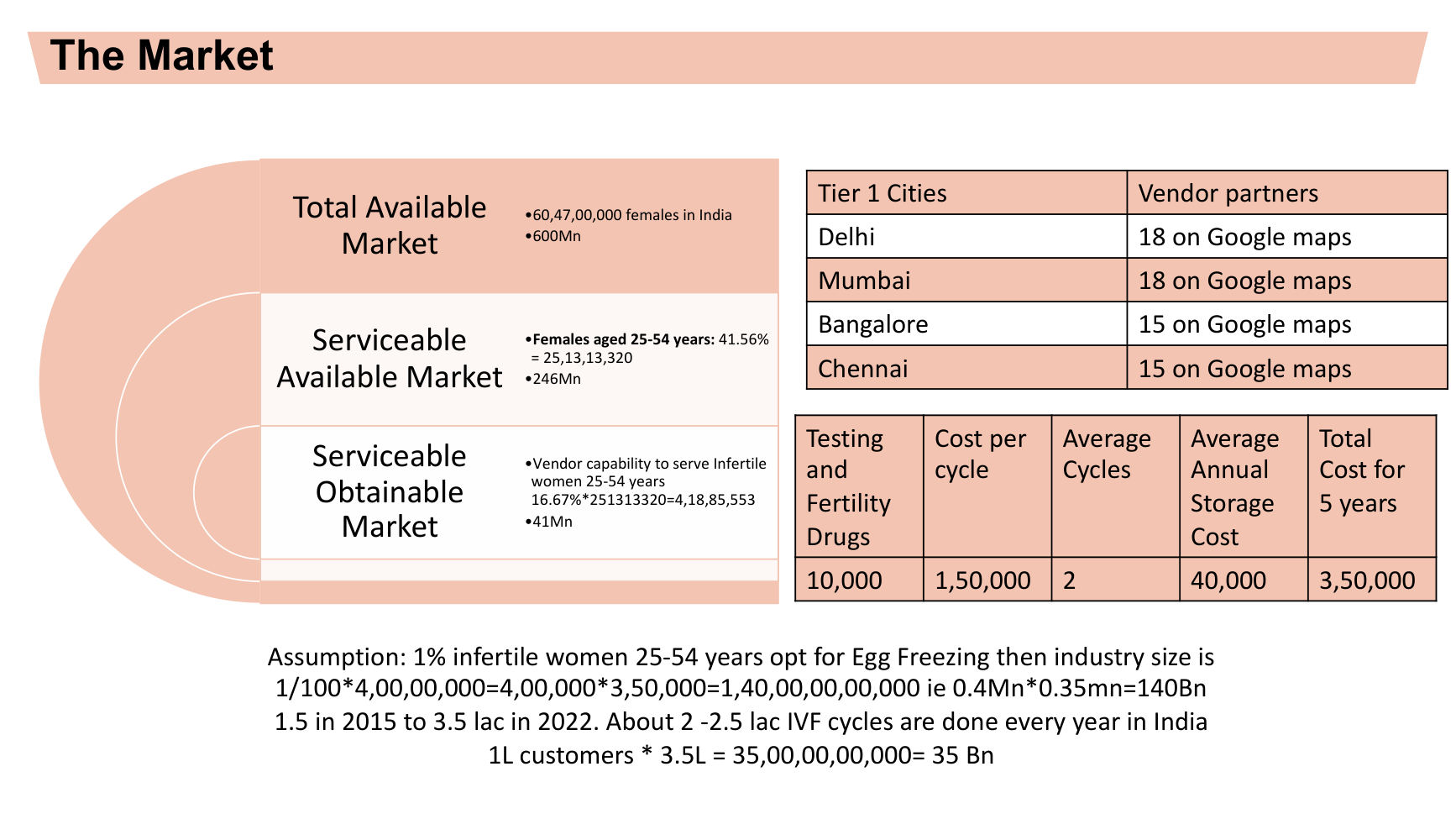
Market sizing built from first principles during the 48-hour sprint. TAM of ₹140Bn if 1% of infertile women aged 25-54 opt for egg freezing at ₹3.5L per cycle. Vendor mapping across Delhi, Mumbai, Bangalore, and Chennai on the right.
The aggregator model didn't exist in this category. There were standalone clinics. There were generic doctor-finder apps. There was no verified, fertility-specific, financing-enabled directory. First-mover advantage was sitting right there.
The same product, four different "why now"s.
I spent the first afternoon doing rapid interviews — friends, friends-of-friends, two clinicians, a fertility coach on Instagram who said yes to a 20-minute call. The pattern that emerged: women came to this decision from very different starting points, but converged on the same question — where do I even start?
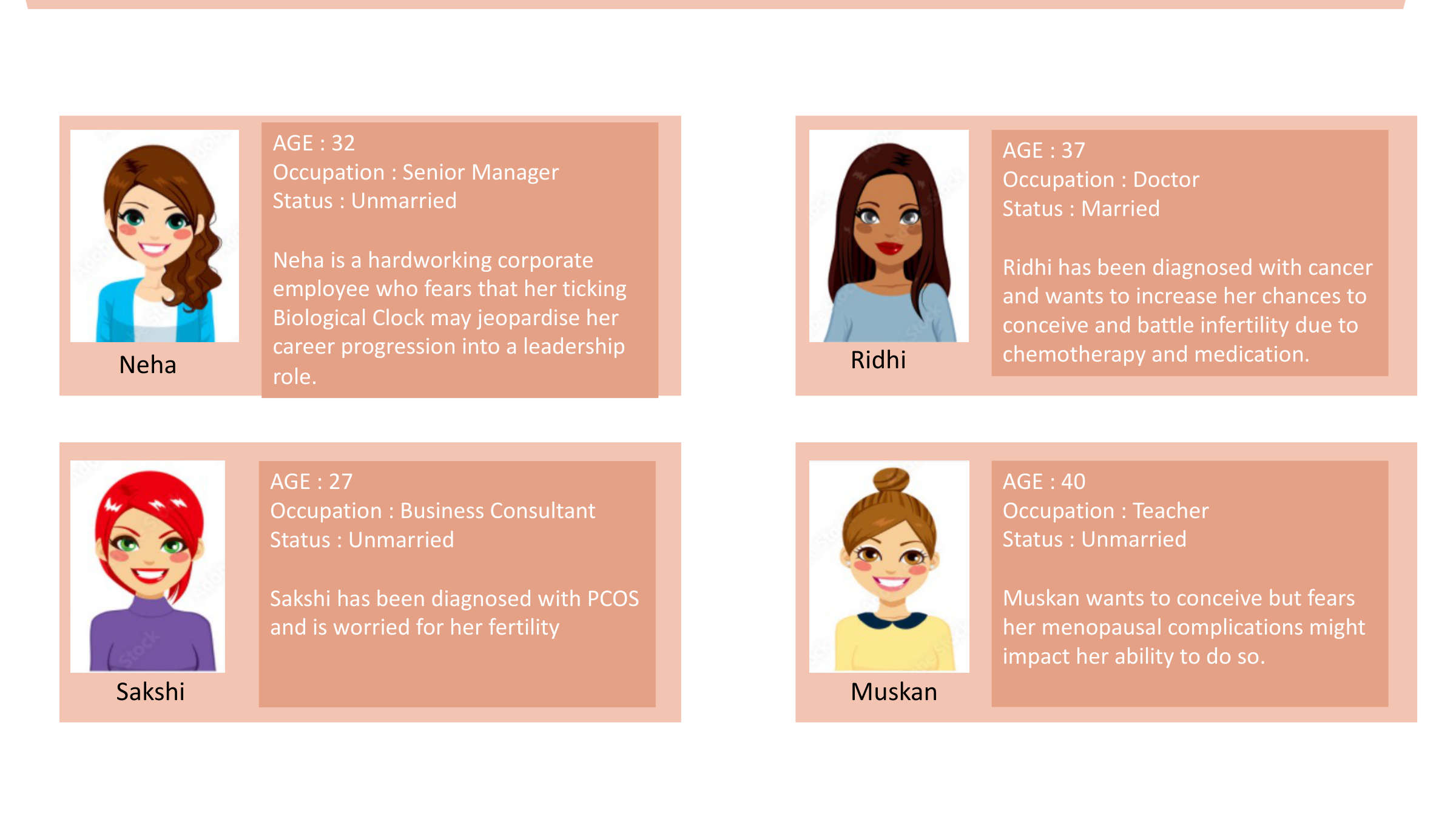
The four personas I built from rapid interviews. Same product, four different "why now" triggers — career timing, PCOS diagnosis, approaching menopause, cancer diagnosis before chemotherapy.
Neha · 32 · Senior Manager
Worried her biological clock will throttle her leadership trajectory. Wants to delay motherhood without giving up the next promotion cycle. High income, high agency, low information.
Sakshi · 27 · Consultant
Recently diagnosed with PCOS. Wants clear, medically accurate options before the condition limits her choices. Reading everything online; trusting almost none of it.
Muskan · 40 · Teacher
Wants to understand if natural conception is still possible — and if not, what's left. Embarrassed to ask her gynaecologist directly.
Ridhi · 37 · Doctor
Diagnosed with cancer. Wants to preserve fertility before chemotherapy starts. Time-pressured, clinically literate, emotionally exhausted.
The unifying insight
Four very different women, four very different "why now"s — but the same first action: a clumsy Google search at 11pm. The product had to be the answer that search was looking for.
One platform. Four entries. Zero shame.
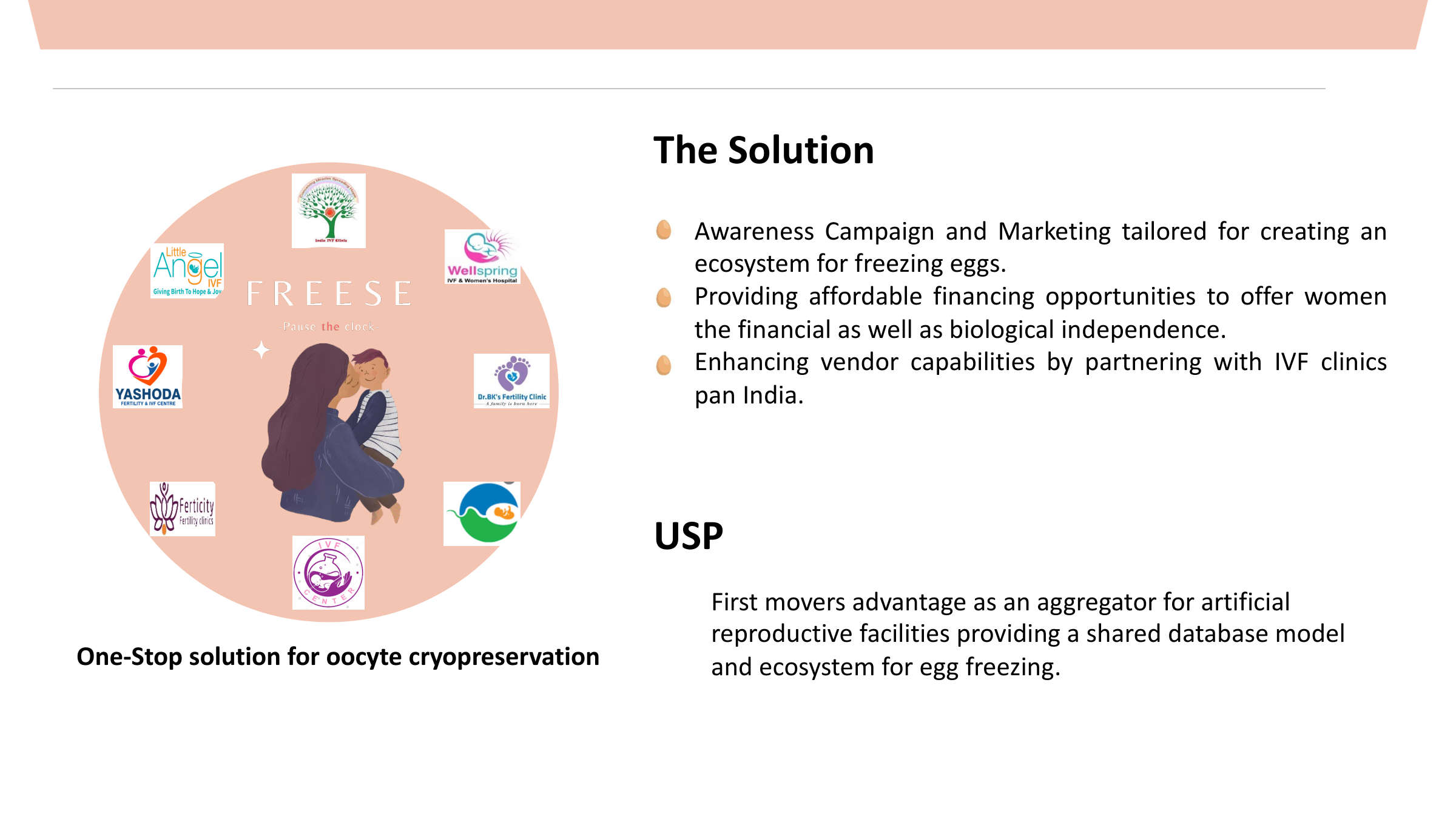
The aggregator model. Freese at the center, IVF clinics across major Indian metros as supply-side partners. First-mover advantage in a space where no aggregator existed.
We built a no-code MVP — a one-stop aggregator for oocyte cryopreservation in India. Four core layers:
- Awareness content. Medically-reviewed explainers, broken down by the four trigger paths (career, PCOS, age, cancer). Designed to be the answer to that 11pm search.
- Verified clinic directory. A curated list of IVF clinics across major Indian metros — vetted for accreditation, transparent pricing, and patient outcomes. Not pay-to-play.
- Financing options. Partnerships with health-finance providers because the procedure cost is non-trivial and rarely covered by insurance.
- Counselling layer. Optional 1:1 sessions with fertility counsellors — because the medical decision is rarely just medical.
Why no-code was the right call
The pitch wasn't "we built a beautiful product." The pitch was "we found a market, validated the user pain, and shipped fast enough to prove we could ship faster." A polished Figma would have looked the part. A clickable no-code site proved the team.
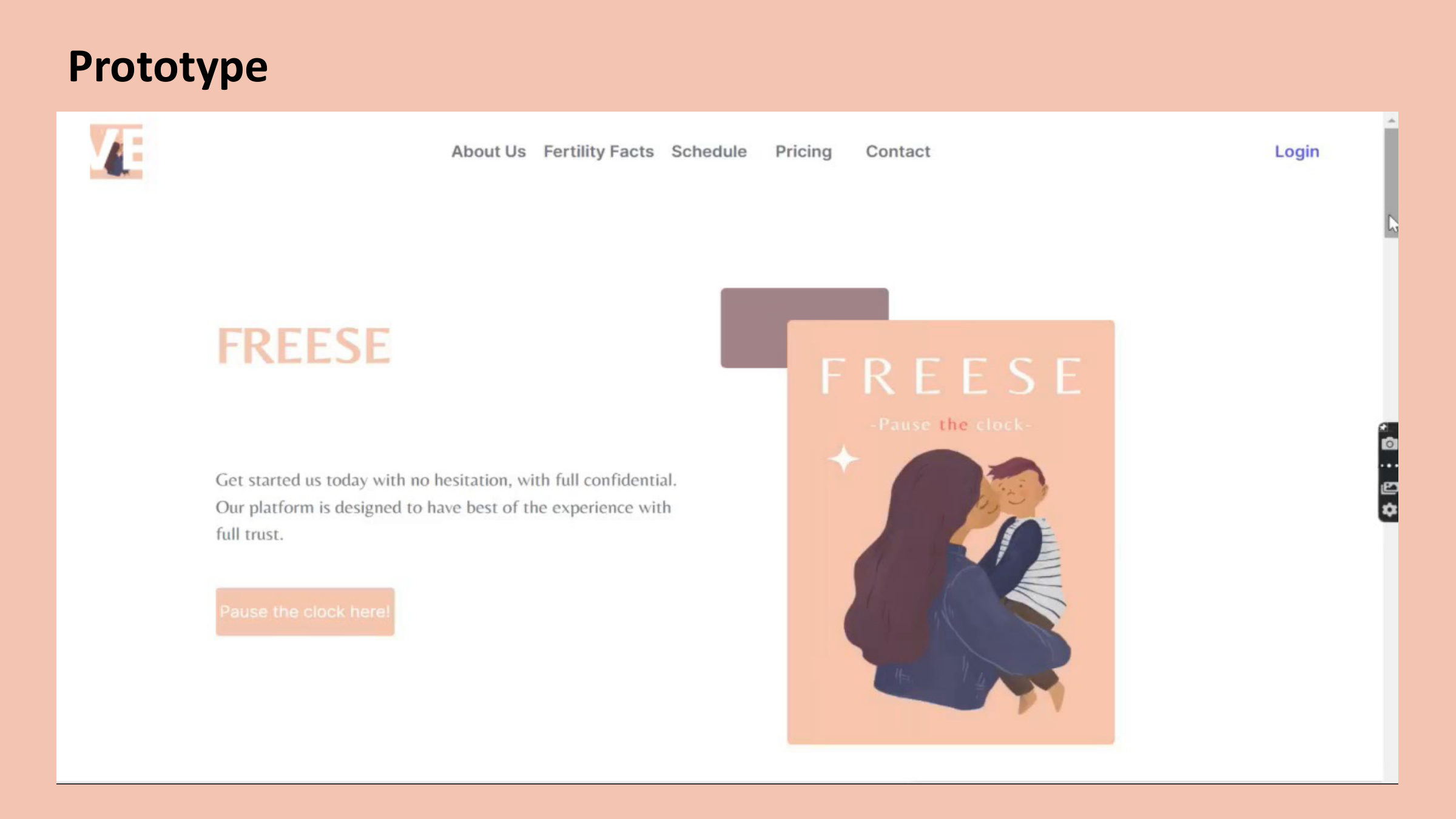
The no-code MVP shipped in 48 hours. A working site with Fertility Facts, Schedule, Pricing, and Contact — enough to click through and demo a real product flow to six VCs.
Six VCs, one Sunday afternoon.
The final pitch was 8 minutes plus Q&A in front of a panel of six VCs. The hardest part wasn't the slides — it was the first 30 seconds. The room visibly tensed when I opened with "We're building India's first egg-freezing awareness platform." Then I showed them the TAM, the personas, the wireframes, the clinic outreach we'd already done. The tension turned into questions.
The questions that mattered:
- "How will you acquire users in a market this stigmatised?" — Through the medical entry point. PCOS communities. Cancer support groups. Career coaches. Going to where the conversation is already happening, instead of trying to start one in the open.
- "What's defensible?" — The verified clinic network. Trust is the moat in a market this sensitive.
- "Why you?" — Because nobody else had bothered to make this their weekend.
The outcome
1st Runner Up. ₹3,00,000 in grant funding. The cheque was bright yellow and roughly the size of a small dining table. (Photo on the home page — I'm still holding it.) More importantly, two of the VCs in the room asked for a follow-up.
The lessons that outlasted the weekend.
Three things stuck:
- Discomfort is often a market signal. If a topic is taboo enough that no platform exists, it's worth asking why — and whether the silence is masking demand rather than the absence of it.
- Speed of validation beats polish of artefact. Nobody in that pitch room cared about typography. They cared about whether we'd talked to actual users. We had.
- "First-mover" is overrated unless paired with "first-trusted." Being first doesn't matter if you can't be believed. In a category like this, trust isn't a feature — it's the entire product.
Freese didn't become a startup I ran full-time. It became a story I tell when someone asks how I think about product. That's a different kind of return on a weekend.